
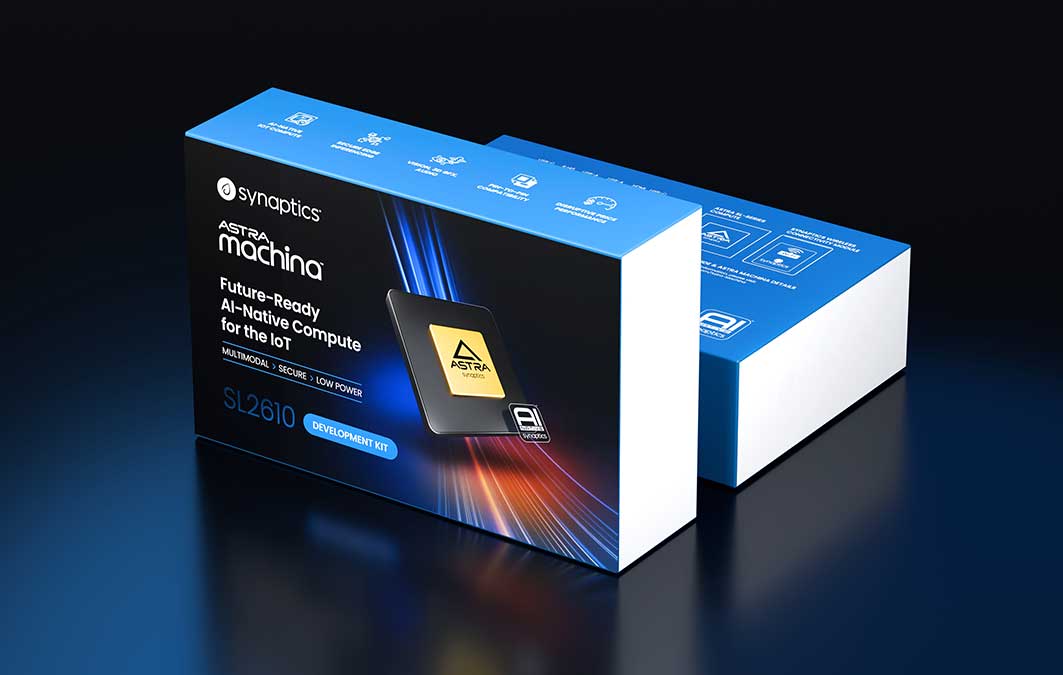
Synaptics has announced a new family of Edge AI processors aimed at powering the next generation of smart, connected devices, as the US semiconductor group expands its push into artificial intelligence.
The Astra SL2600 series is designed to offer high performance at low power for applications across home and industrial automation, healthcare, robotics, retail, and connected consumer devices.
The first product line in the range, the SL2610, includes five processor families built around Synaptics’ new Torq Edge AI platform. The system combines neural processing unit (NPU) architectures with open-source compilers, marking what the company called “the first production deployment” of Google’s RISC-V-based Coral NPU.
Synaptics said the chips integrate Arm Cortex-A55 and Cortex-M52 processors, along with Mali GPUs, and feature built-in security measures such as immutable root of trust and threat detection. The company claims this multi-layered security approach will be critical as more connected devices handle sensitive data locally rather than in the Cloud.
Vikram Gupta, Senior Vice President and General Manager of Edge AI IoT Processors at Synaptics, said the launch “redefines what’s possible for Edge AI,” highlighting power efficiency and scalability as key selling points.
Google, a collaborator on the project, said its Coral NPU integration aims to help simplify AI application development. Yossi Matias, Google’s Vice President and Head of Google Research, said the partnership would “move the industry forward and help make devices even more useful.”
Industry partners including Cisco, Arm, Sonos, Deutsche Telekom, Garmin, and Verisure also voiced support for Synaptics’ Edge AI ambitions.
Analysts see the move as a sign of growing momentum in on-device AI processing, as companies seek to reduce reliance on Cloud infrastructure. Nina Turner, Research Director at IDC, said open-source collaboration such as that between Synaptics and Google “will be an important factor in accelerating innovation and adoption” in the emerging multimodal AI market.
The SL2610 processors will be compatible across five pin-to-pin product families—SL2611, SL2613, SL2615, SL2617, and SL2619—supporting both battery-powered devices and high-performance industrial systems. They also integrate Synaptics’ Veros connectivity technologies, including Wi-Fi 7, Bluetooth, Thread, and ultra-wideband, to streamline product development.
There’s plenty of other editorial on our sister site, Electronic Specifier! Or you can always join in the conversation by commenting below or visiting our LinkedIn page.
Tags Slider