
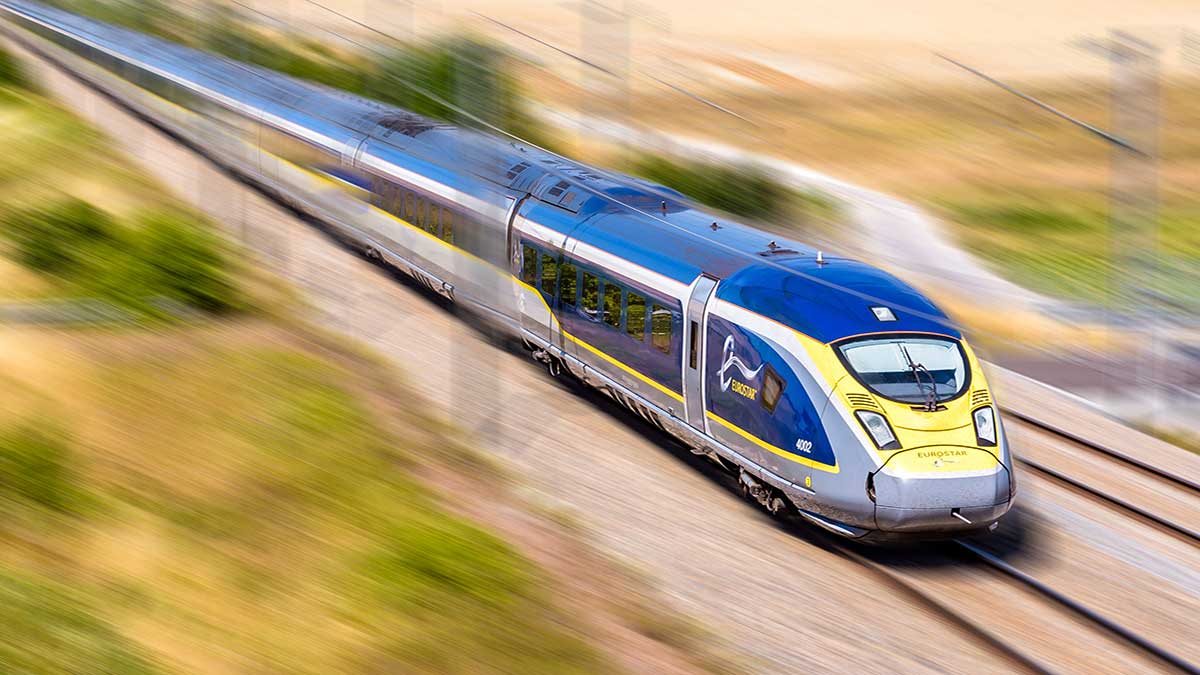
Eurostar is on track to become a Dubai-style fully automated service, as the international train network operator looks to transform its fleet into software-defined trains.
That was the message to delegates at the IoT Expo in London this week as the high-speed international train company sought to position itself as a leader in cutting-edge rail technology.
“We’re still a couple of years away… but to be honest, that’s the way things are going,” said Aamir Tufail, Electrical Systems Engineer at Eurostar, speaking to David Palmer, Chief Product Officer of Pairpoint — the IoT platform jointly owned by Vodafone and Sumitomo Corporation.
“When the driver sits in the cab and sets off the train, a lot of it is fairly automated. Everything’s ready for him. He’s monitoring that all the systems are happy,” Tufail said. Fault codes now appear with recommended remedial actions, allowing drivers to intervene efficiently and safely.
Despite this high level of automation, Tufail pointed out that barriers still remain before Eurostar trains can begin to emulate the driverless trains of the Dubai Metro or the DLR. Cross-border signalling adds complexity, as Eurostar trains navigate different systems in the UK, France, Belgium, and the Netherlands. Full autonomy will require software capable of managing these variations safely — a significant technical and regulatory challenge.
Still, his comments highlight the company’s ambition to move beyond hardware-led operations and make software, sensors, and AI the core of its fleet management.
“Instead of looking for an improved product in terms of hardware, we’re looking to the software,” Tufail said. “How can we make that more resilient and keep updating it in line with IoT and everything being developed nowadays?”

Reliable connectivity underpins Eurostar’s software-led approach. The operator is exploring satellite, mobile, and fixed-network solutions to maintain communications even through the 20-minute Channel Tunnel stretch.
“Security is the priority. Whether someone could watch Netflix on the train or something like that is secondary, but we have to make sure that all our systems can communicate, even if we’re in a dead spot,” Tufail said.
The company’s ambitions to provide connectivity through the Channel may by looked upon with scepticism by some customers, especially the thousands of passengers left stranded during the New Year’s holidays due to an electricity failure in Europe’s longest undersea tunnel.
Nonetheless, Tufail said that the company had been quietly implementing IoT-based maintenance systems on board which reduces downtime, improves reliability, and maximises train availability on the busy international routes between London, Paris, Brussels, and Amsterdam.
“Initially, we did a lot of time-based maintenance,” Tufail explained. “Whether or not something needed changing, you changed it, whether it was a wheelset, an axle bearing, or a pump.” While effective, this approach was inefficient: components were often replaced before the end of their useful life, increasing downtime and operational costs.
Today, sensors monitor the health of individual components in real time, giving engineers precise insight into when replacements are actually required.
“Now the train is communicating well with all the systems and all the components. We can see at what point certain components start to scream for help,” Tufail said. Components can be replaced slightly earlier or later than the manufacturer’s nominal schedule, depending on actual wear.
“Instead of changing it every six years, maybe it’s five-and-a-half, or five. Or the opposite way, we might find after six years that it’s perfectly fine and it can run for another two or three years.”
Sensor data feeds predictive models, helping engineers anticipate issues before they occur. “We feed it all the data, for example wheel measurements, and it outlines where we might have degradation,” Tufail said. However, human oversight remains critical. “We don’t want to completely rely upon it. We’ve seen it give the wrong answer very confidently. Our role as engineers is to verify what it’s telling us.”
Moreover, Tufail added, operating trains at speeds of up to 200 miles per hour across multiple countries makes Eurostar a particularly demanding environment for IoT and software systems.
Sensors must survive ballast dust, brake debris, and extreme temperature changes while providing accurate, actionable data.
“If we can make IoT work on a train that’s going 200 miles an hour, I think we can make it work anywhere else,” he said.