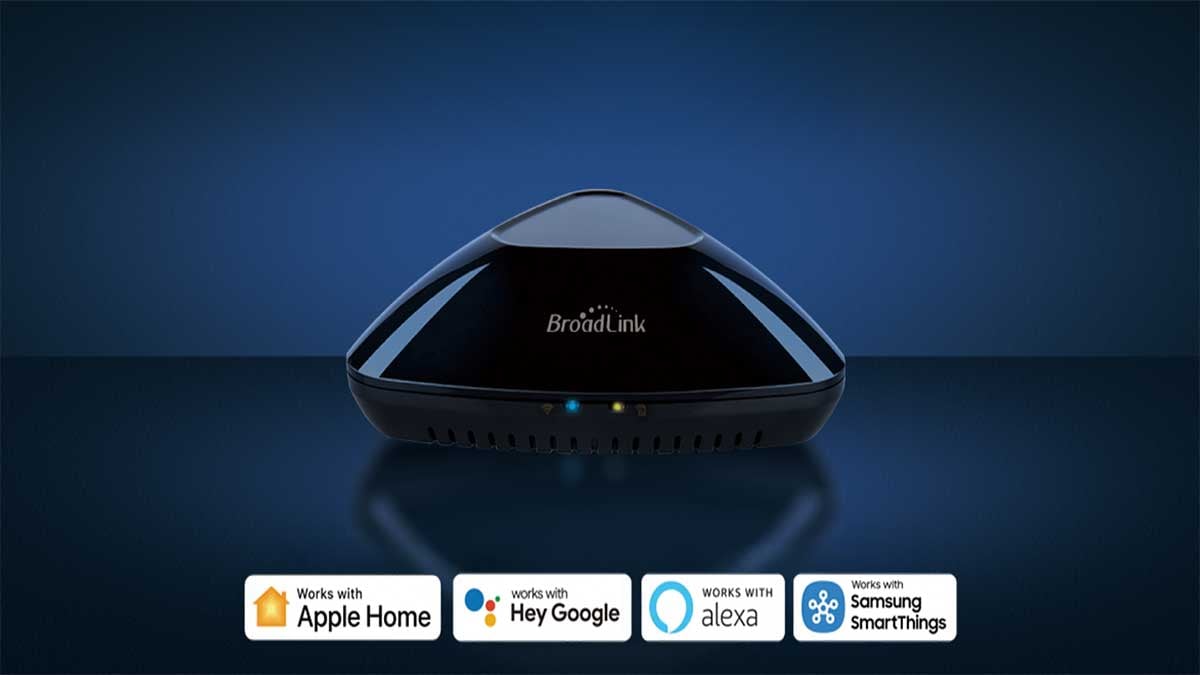
Chinese tech firm BroadLink has launched what it says is the world’s first “Matter SuperBridge,” targeting a long-standing problem in the smart home market: how to connect legacy appliances to modern, interoperable platforms.
The device, known as the RM MAX, arrives as the industry accelerates its shift towards Matter, the connectivity standard backed by Apple, Google, Amazon, and Samsung.
Matter is designed to simplify device setup and improve cross-platform compatibility, but its reach has so far been largely limited to new products.
Most appliances already installed in homes continue to rely on infrared and radio-frequency controls, leaving air conditioners, fans, heaters, lighting systems, and motorised equipment outside the newer smart home ecosystems.
BroadLink’s approach is to insert a translation layer rather than require replacement. The RM MAX bridges traditional IR and RF protocols with IP-based smart home systems, allowing existing devices to be controlled through Apple Home, Google Home, Amazon Alexa, and Samsung SmartThings without rewiring or hardware upgrades.
The company says the device supports more than 98% IR and RF compatibility with global appliance brands, reflecting the realities of residential environments where replacement cycles for major appliances often stretch over decades. For manufacturers and platform providers, this has become a structural challenge as standards evolve faster than households can realistically upgrade their equipment.
“Consumers don’t want to replace everything they already own just to adopt a new standard,” said Moon Zhou, Global CEO of BroadLink. “RM MAX is about continuity, not disruption. It ensures Matter works not only for new devices, but for the real homes people live in today.”
A key design feature is local operation. Devices can be paired without an internet connection, with control handled locally across IR, RF, and BroadLink’s FastCon system. The RM MAX also supports local voice control via Siri, allowing basic functionality to continue during network outages.
The device incorporates mesh networking designed for larger deployments, supporting up to 4,096 devices per local network and offering a single-node transmission range of up to 80 metres. While aimed primarily at homes, this capacity could extend its use into multi-room properties and light commercial settings.
Data security has also been positioned as a differentiator. In response to rising concerns among US consumers about privacy, BroadLink has designed the RM MAX to store all device data and usage information locally on the device rather than in the cloud. By keeping data on the edge, the company says it reduces exposure to breaches associated with cloud-dependent hubs.
BroadLink demonstrated the RM MAX publicly at CES 2026, showing live integrations between legacy IR and RF appliances and next-generation smart home platforms. The appearance marked the company’s first major US showcase since before the COVID-19 pandemic, signalling a renewed push into the North American market.
Commercial availability is scheduled for early February 2026. As interoperable standards gain momentum, products that extend connectivity to existing devices may prove critical in determining how quickly smart home technologies move beyond early adopters and into the mainstream.
There’s plenty of other editorial on our sister site, Electronic Specifier! Or you can always join in the conversation by visiting our LinkedIn page.