
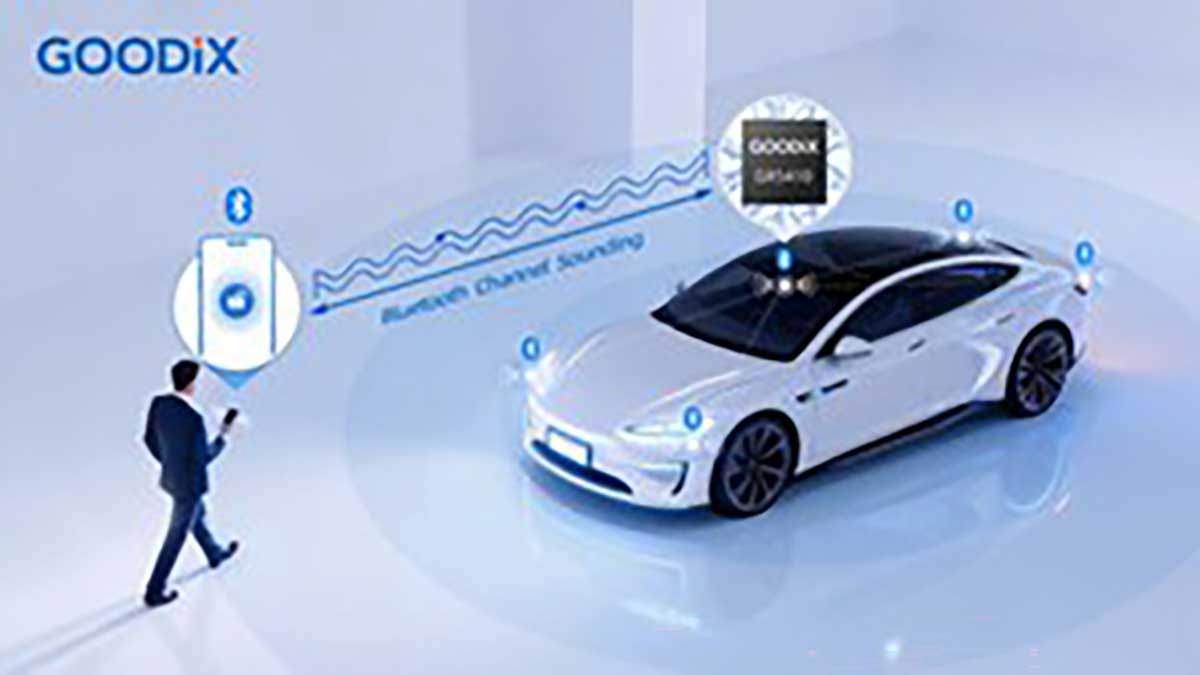
China-based Goodix Technology has unveiled a next-generation automotive-grade Bluetooth LE system-on-chip as the industry moves towards hands-free digital car keys and more precise in-vehicle wireless connectivity.
The Shanghai-listed company said its GR5410 chip is among the first to be developed in line with the Bluetooth SIG’s newly released Bluetooth Core Specification 6.1.
Digital car keys, which allow drivers to unlock and start vehicles simply by approaching them with a smartphone, are increasingly seen by carmakers as a core feature of connected vehicles.
The GR5410 supports Bluetooth 6.1 Channel Sounding, a technology designed to improve ranging accuracy, privacy protection, and energy efficiency. Goodix said it is among the first semiconductor vendors to achieve both Bluetooth 6.1 BQB certification and Channel Sounding certification, a milestone that could accelerate adoption by automakers and Tier 1 suppliers.
Designed as a single-chip wireless microcontroller unit, the GR5410 integrates a Bluetooth 6.1 module, a Channel Sounding unit, and a CAN FD interface. The architecture is aimed at automotive and other performance-critical environments, where reliability, security, and low power consumption are essential.
At the core of the chip is Arm China’s STAR-MC1 processor, which incorporates a security-focused architecture. Features include secure boot, encrypted storage, protected debugging, and a hardware security module based on a one-chip-one-key mechanism, intended to safeguard digital car key systems and in-vehicle networks.
Goodix said the chip also offers early support for passive anchor multi-node ranging, enabling multiple nodes to complete synchronised ranging in around 200 milliseconds. Combined with the company’s proprietary AI-based ranging algorithms, the system is designed to achieve accuracy of up to ±50 cm at distances of more than 50 metres.
The GR5410 runs on Goodix’s own low-power Bluetooth protocol stack, which supports RSSI broadcast scanning, RSSI monitoring, and Channel Sounding ranging. This is intended to give automakers flexibility in deploying different digital car key and in-vehicle communication scenarios.
According to the company, the chip has already been selected for projects by several automakers and Tier 1 suppliers, with pilot production scheduled for the first quarter of 2026. Goodix said its broader digital car key solutions are already in commercial use across more than a dozen vehicle models from mainstream Chinese manufacturers.
As carmakers push towards greater vehicle intelligence and connectivity, Goodix said it plans to continue investing in wireless technologies, positioning Bluetooth-based solutions as a foundation for more secure, convenient, and connected mobility experiences.
There’s plenty of other editorial on our sister site, Electronic Specifier! Or you can always join in the conversation by visiting our LinkedIn page.