
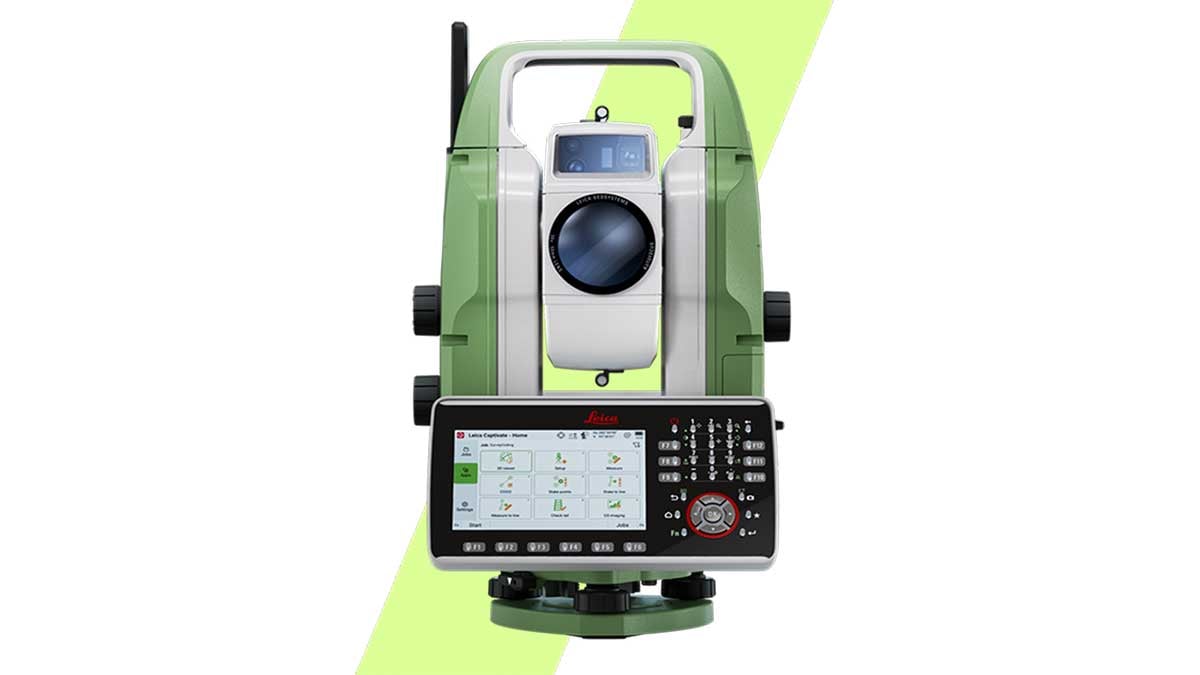
In high-pressure environments like construction sites and tunnels, surveyors face complex challenges that require precision and resilience. Burkhard Boeckem, Chief Technology Officer at Hexagon explores how advancements in smart technology, such as Edge computing and AI, are helping them make real-time decisions, and next gen robotic instruments like the Leica TS20, are demonstrating how technology can enhance performance and reduce human error.
Industries operating in extreme or unpredictable environments, whether tunnels or active construction sites, face a dual challenge: complex physical conditions and high-stakes decision-making. Building resilience requires tools that can adapt and reduce human error under pressure. Advances in Edge computing and AI are enabling professionals to make real-time, autonomous decisions even when networks are unreliable or conditions are harsh.
For surveyors, integrating AI, it helps teams to survey accurately, capture precise data, detect errors early, and maintain operational continuity, showing how technology can empower resilience rather than just automate tasks.
Connectivity is the backbone of field operations
In remote or infrastructure-heavy environments, secure and reliable communication is essential for efficiency and safety. Modern instruments are increasingly designed to perform seamlessly across any setting, from isolated rural sites to busy urban developments. Edge AI allows these systems to operate autonomously without relying on Cloud access, while integrated communication channels, such as mobile data and Wi-Fi, adapt to varying site conditions. Whether surveyors are working in GNSS-denied environments such as tunnels, or setups requiring direct cable connections, connectivity and positioning adapt in real time. By combining autonomous operation with flexible, reliable communication, professionals can maintain precision and control even in the most challenging field environments.
AI, automation and the productivity gap
Surveying and construction industries face a productivity gap driven by time pressures and the demand for absolute accuracy. By introducing automation and AI, these challenges can be alleviated, not by replacing skilled professionals, but by enhancing their capabilities.
With AI taking on the time-consuming aspects of the job, surveyors and site managers can dedicate more attention to solving complex on-site challenges. This combination of human expertise and intelligent automation improves output, reduces risk, and allows teams to maintain high performance even under demanding conditions.
Importance of Edge AI when making smarter decisions
Edge AI is transforming how field professionals operate in complex, high-pressure environments. By embedding a Neural Processing Unit (NPU) directly into instruments, data processing happens on-device rather than in the Cloud. This enables instant insights while reducing power consumption and preserving data privacy, allowing surveyors to work efficiently even in areas with limited or no network access. Beyond speed, the NPU drives smarter field operations: it supports autonomous workflow optimisation and reliable measurements with minimal manual intervention. These capabilities streamline decision-making, enhance operational accuracy, and demonstrate how intelligent, Edge-based processing can empower resilience and productivity in real-world environments.
Key engineering challenges when building the Leica TS20
Building instruments that combine high automation with extreme durability requires a unique engineering approach. Creating a total station that is both highly automated and IP66-rated demanded careful integration of advanced AI and automation systems into a design capable of withstanding rain, dust, and continuous field use. This precision extends to every component, from cameras to Electronic Distance Measurement (EDM) systems, ensuring fast, reliable operation in even the most demanding environments. Balancing automation and resilience allow professionals to depend on their tools for accurate data and smooth workflows, reinforcing operational confidence and efficiency across challenging sites.
Author biography:
Burkhard Böckem was named Hexagon’s chief technology officer in 2020 after serving as CTO of Hexagon Geosystems since 2015. In the latter role, he oversaw technology, innovation and product development for all of the Geosystems business units. He began his career in 2001, when he joined Leica Geosystems. As CTO of Hexagon, Böckem drives the innovation and continued development of Hexagon’s autonomous technology vision. He holds a Master of Science in geodesy and a Ph.D. in technology.
There’s plenty of other editorial on our sister site, Electronic Specifier! Or you can always join in the conversation by visiting our LinkedIn page.