
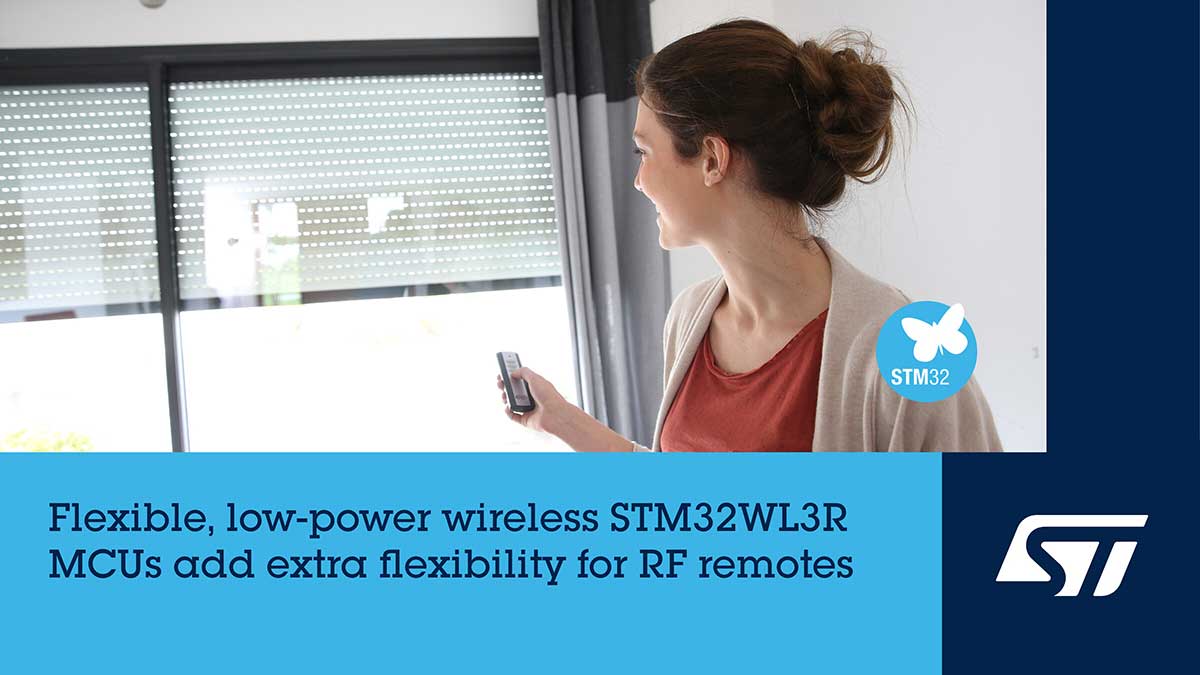
STMicroelectronics has unveiled a new low-power wireless microcontroller aimed at improving the performance and battery life of remote controls used in consumer electronics and home-automation systems.
The STM32WL3R is an evolution of the company’s STM32WL3 sub-GHz platform and incorporates a power-efficient RF transceiver, extended power-saving modes, and six independent wake-up pins. The company said the device is designed to help manufacturers build more responsive remotes with longer operating lifespans.
The product was co-developed with Somfy, the France-based building-automation group known for its connected shutters, garage-door systems, and smart-home controls. Somfy engineers worked with STMicroelectronics to tailor the microcontroller for new RF remotes and sensors. Serge Robin, RF Development Manager at Somfy, said the single-chip design would support the company’s aim to deliver “smarter, more comfortable, and environmentally friendly buildings”.
The STM32WL3R is the first Cortex-M0+ multiband wireless microcontroller to operate in the 315MHz band used for remote controls in North America. It also supports the 850MHz and 950MHz ISM bands, enabling global product deployment.
Patrick Aidoune, Group Vice President and General Purpose and Automotive Microcontrollers Division General Manager at STMicroelectronics, said the device builds on the company’s radio-efficiency work in sectors such as metering and asset tracking. He noted that the transmitter draws only 10mA at 10dBm output power, a level he described as unmatched in the market.
The microcontroller includes newly designed low-power states intended to cut consumption while retaining RAM data, reducing wake-up times, and improving responsiveness. An ultra-deep stop mode draws 450nA with 16KB of RAM retained, while a 14nA shutdown mode supports up to six wake-up inputs. STMicroelectronics said the additional wake-up lines would make it easier for manufacturers to build feature-rich remotes and reuse circuit-board designs across multiple models.
There’s plenty of other editorial on our sister site, Electronic Specifier! Or you can always join in the conversation by visiting our LinkedIn page.